

I have ventured from my office to meet Klaus Zimmermann at a truck park just north of München, here in Bavaria, writes Transport News European transport correspondent Peter Schmitz.
I am writing a story on lorry drivers who wait for a long time at places where they shouldn’t have to wait for a long time, and someone says, ‘speak to Klaus Zimmermann’. Okay.
Klaus Zimmermann is a lorry driver.
German names for lorry driver include lastwagenfahrer or LKW-Fahrer, this is a standard term, and there is fernfahrer – long-distance driver, and berufskraftfahrer covers all ‘professional’ drivers from taxis to buses to trucks.
After our introduction, I establish that Klaus is a fernfahrer.
As we stand by his Scania truck, he is scrolling through his phone to show me images of a warehouse in England. As far as I am aware, it is not a hobby.
“I was bored,” he confirmed, “so I began to take pictures of things to help me pass the time.”
These images are of a counter, empty seats next to desks littered with paperwork and cumbersome looking landline phones, next is a registration book for logging arrivals and departures, then of some plastic chairs, some magazines on a table, a coffee machine, a bin, the window…
You get the picture.
We go back to the registration book and here Klaus has written his name and his arrival time. “For many hours I wait,” he says recalling his experience with a nonplussed shrug of the shoulders.
Klaus has been driving trucks for many years. He can remember the time before Schengen, when the borders were up and paperwork – the correct paperwork – was a necessity.
Back then, waiting was to be expected but usually at border crossings; an occupational hazard for the international truck driver. Delivering inside Bulgaria, East Germany and Poland, often meant waiting.
An officer of the law or military would inspect the truck and trailer before a clerk went through it with a fine-tooth comb and would then give the nod to the officer to either wave the driver through or strip it to the metal. “Genau prüfen,” he confirms; ‘check carefully’.
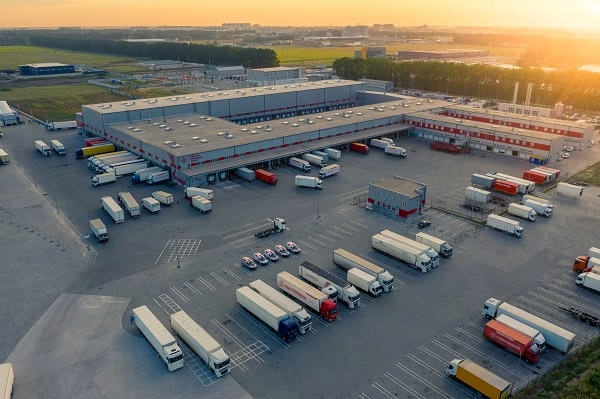
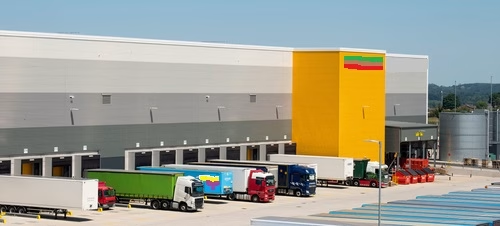
Today, the border is at the company’s front door. And for Klaus and his trailer of ‘consumables’ that means security at big corporate warehouses.
Klaus explains the drill. First processing at the security gate when you are cross-referenced with an arrival time ‘window’, then parking and waiting for a loading bay light to be green or for another truck to leave, then providing staff with the paperwork and demonstrating that the truck keys are with you and not in the cab, then unloading, then getting the paperwork signed, then escaping without additional checks at the security gate.
“Things can be bad, luckily I have a coffee machine and the ‘vape’…”
These days most of his trips are closer to home but occasionally he has to fish out his English phrase book and head to Brexitland.
As the Euro Rastpark Schweitenkirchen lorry park is beginning to fill up. Klaus and I retire to the café. In German he explains in some detail what happened in England at a warehouse. Paperwork, language barrier, park, green light, wait…
The story ends with a cursory German swearword. “Scheiße!”
The point he makes is that the downtime only affects his ability to maximise his driving hours each day, it means he will fall behind his schedule and ‘I am paid a salary’.
His boss gets angry at the delays, as it costs money, around €60 an hour for doing nothing.
I ask if he heads to Italy very often. “Nein.”
However, news that the Italians look set to introduce truck waiting fees piques his curiosity. Possibly €100 per hour and it is non-negotiable.
First you have to wait 90 minutes, then as soon as the first minute trips into the next hour, and every hour thereafter it’s a mandatory €100.
This is word from the Italian Ministry of Infrastructure and Transport (MIT); it was originally introduced in the summer of 2025.
Both the shipper and the party responsible for loading are jointly liable for payment. Time keeping is via digital tachographs and GPS systems.
“The English owe me €300,” Klaus roars with laughter.
It is an interesting concept, charging shipper and the party responsible for loading for delays, and perhaps long overdue.

Shutterstock.
Despite all this, Klaus is a pragmatist. He is, after all, a ‘fernfahrer’ and he has learned to cope with disappointment. And he dusts off the most German phrase to sum up my waiting time story.
“Alles hat ein Ende, nur eine Wurst hat zwei,” he declares.
“Everything has an end. Only a sausage has two.”
He’s right, of course, nothing lasts forever.


