
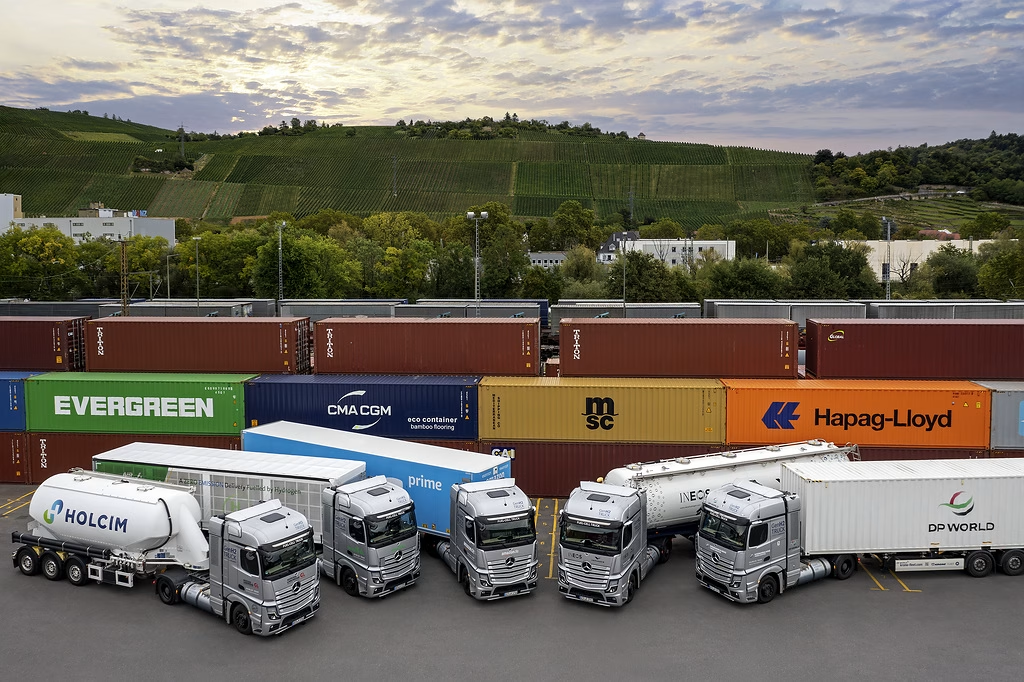
In theory, the first net zero journey around the world was by Phileas Fogg in his hot air balloon in 1872, writes Transport News’ European correspondent Peter Schmitz.
Unfortunately, the 80-day adventure was a figment of imagination belonging to Jules Verne; a French novelist, poet and playwright.
It would be a further 127 years when the first actual ‘around the world’ hot air balloon flight was achieved in 1999 by Swiss national Betrand Piccard and a Brit called Brian Jones. And it was done in just 20 days.
The key thing here is scale. Around the world is up there with double decker buses and football pitches as a way of telling us how far or big something is.
So, news that each of the five Daimler’s fuel cell trucks have successfully completed more than 40,075 kilometres (24,901 miles) – a ‘around the world’ lap – using emission-free hydrogen is something to which we can relate.
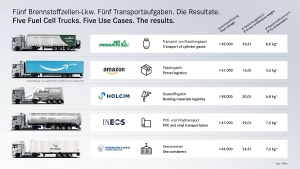
In total the five trucks racked up 225,000 kilometres (139,000 miles) or five and a half times around the world in what the manufacturer calls ‘real-world customer operations’.
These customers are Air Products, Amazon, Holcim, INEOS Inovyn and Wiedmann & Winz.
The year-long trial began in July 2024 with the trucks on specific routes within Germany during the trial period and took on various transport tasks.
In all, reports Daimler, there were 285 refuels with a total of around 15 tonnes of liquid hydrogen (sLH2 standard) done in Woerth am Rhein, Southern Germany, and Duisburg, Western Germany
Michael Scheib, head of entire vehicle development at Mercedes-Benz Trucks, said the initial customer trials are extremely valuable for the further development of the fuel cell trucks.
“By deploying the GenH2 Trucks in real-world logistics operations, we have been able to demonstrate their performance, reliability and efficiency across various transport applications and gain important insights,” he continued.
“This enables us to refine the technology and vehicles according to the specific needs of our customers all the way to series production. Furthermore, the intensive use of the liquid hydrogen fuelling stations during the trials enables further optimization of the refuelling process.
“All these practical experiences also help us to optimally prepare our sales and service for the deployment of hydrogen trucks for our customers.”
Feedback from customers cite ease of use – practicality similar to that of today’s diesel trucks – and welcomed relatively short refuelling times up to 15 minutes.
Daimler Truck.
Thomas Hollad is the transport and asset manager northern continent at Air Products. He said: “The vehicle has operated reliably throughout the trial, and the Daimler Truck team’s responsiveness and technical support have been valuable in resolving any minor issues quickly and professionally.”
Director EU surface transportation operations at Amazon Transportation Services Fabian Duex said: “During the trial, it consistently achieved ranges of over 1,000 kilometres on a single tank, and the truck operated smoothly in a five-day-a-week schedule. Based on our partner’s experience with the pre-series vehicles, the GenH2 Truck shows promising maturity.”
Roger Haschka, global category manager trucks & trailers at Holcim Technology Ltd, commented: “The Mercedes-Benz GenH2 Truck demonstrates that hydrogen propulsion is a viable technology for the future. For the sustainable decarbonization of our Scope 3 emissions – in addition to the use of battery-electric trucks – the key challenge for the industry is to create an economical, TCO-based business case that allows the vehicle to be operated without cost disadvantages.”
Frédéric Derumeaux, CEO VERVAEKE, said: “Together with our customer INEOS Inovyn, we were able to achieve high operational performance, which was only possible thanks to the flexibility and coordination of all those involved. The drivers who used the Mercedes-Benz GenH2 Truck grew to love it in operational use and appreciate both its powerful performance and comfort.”

William Turner.
And Dr Micha Lege, managing director, Wiedmann & Winz, concluded: “The Mercedes-Benz GenH2 Truck is on a par with the diesel Actros in many ways – that makes it so valuable for us. We cannot afford to rely on just one technology. In order for the drive system revolution to work, we need a technology mix of battery-electric and hydrogen trucks. With the fuel cell from cellcentric, we use state-of-the-art technology made in Germany.”
Daimler is already plotting the next stage; namely more after-sales locations to handle fuel cell trucks, to optimally support the planned 100 small-series vehicles of the next generation of the Mercedes-Benz GenH2 Truck.
Hydrogen is only part of the solution, and Daimler Truck continues with its battery-electric development as well. Eggs and baskets.
And just in case you were wondering, ‘around the world’ is the equivalent to 4,782,219.5 AEC Routemaster double decker buses.


